
Size process cooling capacity and prepare quotations
Factories lose money when a chiller cannot hold temperature, pull down a batch, or operate well at low load. The right industrial water chiller is a process decision, not a catalogue decision.
For food plants and manufacturing facilities, a useful quotation starts with temperatures, flow, and production schedules. Collect these before comparing machines.
An industrial chiller removes heat from liquid circulating through tanks, moulds, or heat exchangers. Identify where heat enters and how quickly it must leave.
Record supply and return temperatures, flow, and cooling time. Use peak production for continuous lines and the largest batch for batch processes. List shared loads separately.
The basic heat balance is simple: cooling duty equals mass flow multiplied by the fluid heat capacity and the temperature difference. The refrigeration system must also cover heat from pumps, piping, tanks, motors, warm product, and the surrounding room. A supplier should check the calculation against actual operating data before selecting a compressor.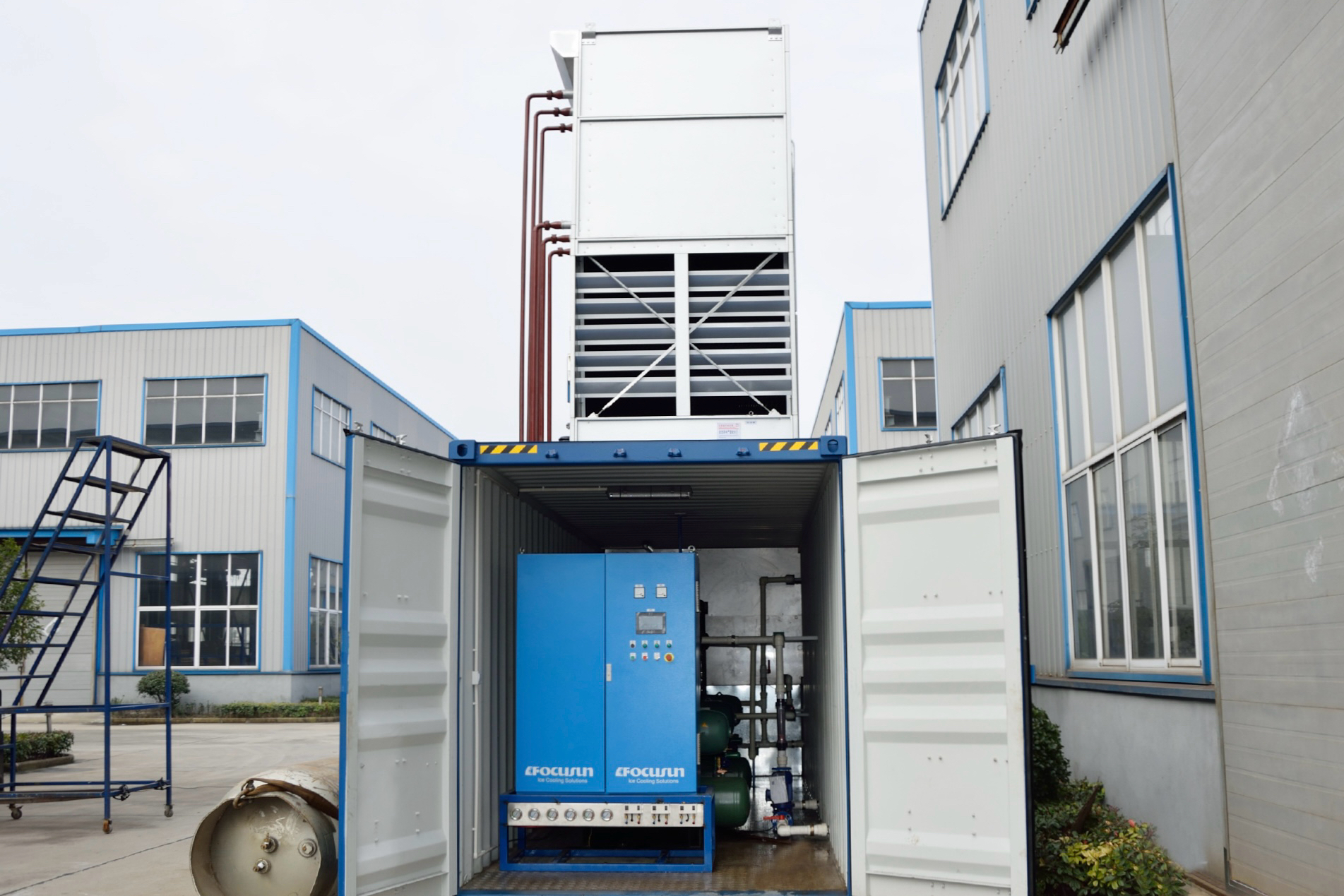
The process load includes product heat, equipment heat, heat through tanks and pipework, and the pull download when a warm batch enters. Note the maximum inlet temperature, target outlet temperature, flow rate, operating hours, ambient temperature, and whether the loads operate simultaneously. A transparent load sheet makes quotations easier to compare and leaves room for future expansion.
Many plants need a margin for weather, fouling, or measurement variation, but excessive allowance can create short cycling and higher cost. Focusun’s process cooling article lists practical project data, including pull-down time, coolant type, and redundancy.
Clean water is efficient and easy to pump when the required temperature stays above freezing. It is often suitable for beverage, food, mould, and general equipment cooling. If the leaving temperature may approach 0°C, or if a line can stop in a cold room, a glycol mixture may protect the evaporator and piping from freezing.
Glycol changes viscosity, heat capacity, and pressure drop. The percentage should therefore be stated in the quotation, not added later by an installer. A high concentration is not automatically safer because it can increase pump power and reduce heat-transfer performance. The chiller, pump, seals, heat exchanger, and control setpoints must all be compatible with the selected fluid.
For food plants, the chilled liquid usually circulates through a hygienic heat exchanger or jacket rather than touching the product. The design needs cleanable materials, suitable connections, and separation between process water and refrigerant. Focusun’s chemical and medical cooling page is useful when monitoring or documentation is important.
An air-cooled industrial water chiller is straightforward to install and does not need a cooling tower, making it useful where water is scarce, or space is limited. Its capacity is affected by outdoor temperature and coil cleanliness. The Focusun air-cooled chiller range shows the protection and operating information buyers should expect. Water-cooled systems can be efficient at larger steady loads, but add tower, pump, and water-treatment requirements. Compare the whole installation and ask for capacity at the real design condition.
Compressor type depends on capacity, redundancy, and service strategy. A larger site may prefer multiple circuits so one can operate while another is serviced. The right answer depends on the process profile and local technical support.
A chiller can have enough capacity and still fail if flow is wrong. Confirm pump head, piping, valves, strainers, and buffer volume. Long pipes and fittings add friction losses; elevation also matters in open circuits. Ask for the pump selection against actual circuit resistance. A buffer tank can reduce compressor cycling as loads change.
Insulate cold piping and protect it from condensation. Poor insulation adds heat and can wet the floor. Select a cleanable finish in food or pharmaceutical areas.
Define the acceptable supply and return range, alarm limits, restart behaviour after a power cut, and the points that must be recorded. Useful signals include temperature, flow, pressure, compressor status, and common fault alarms.
Variable-speed fans or compressors can help a system follow a changing process load. That benefit depends on good control logic and correct minimum-flow protection. Ask how the machine handles low load, warm start, freeze protection, and sensor failure. If the site has a plant management system, request the communication protocol before the electrical design is frozen.
Remote monitoring should complement local alarms and a clear response plan. Commissioning should include sensor calibration, alarm testing, trend records, and operator training.
Food and beverage buyers should consider cleaning access, drain management, and separation from dirty utilities. Industrial users should plan condenser cleaning, refrigerant service, pump seals, and spare parts. Ask for a preventive maintenance schedule. Energy cost is shaped by setpoint, ambient condition, fluid concentration, pump head, and part-load hours, so compare power at both design and typical load.
Prepare one page with the following details before contacting a manufacturer. If an item is unknown, state that it needs confirmation.
|
Project item |
Information to provide |
Why it matters |
Typical buyer question |
|
Process |
Product, equipment, batch or continuous operation |
Identifies the real heat sources |
Can several loads run together |
|
Temperatures |
Inlet, outlet, return, and ambient design values |
Sets refrigeration duty |
What happens on the hottest day |
|
Flow |
Liquid type, flow rate, pipe length, pressure drop |
Sizes pump and heat exchanger |
Is glycol required |
|
Operation |
Hours, pull-down time, future expansion |
Tests capacity and part-load control |
Is standby capacity needed |
|
Site |
Voltage, space, ventilation, water availability |
Determines configuration |
Air cooled or water cooled |
|
Service |
Local technicians, spare parts, monitoring |
Reduces downtime risk |
What is included after commissioning |
If your figures are incomplete, send the process description anyway. Focusun supplies water chillers, refrigeration units, pumps, controls, and integrated layouts. Review the water chiller collection and use the contact page to share temperatures, flow, site conditions, and production schedule. A quotation that explains its assumptions can then be compared on capacity, stability, energy use, and serviceability—not just the nameplate.
An industrial water chiller removes heat from circulating water or a water glycol mixture and sends the cooled liquid to process equipment. Typical uses include food and beverage lines, moulds, chemical vessels, pharmaceutical equipment, laboratories, and heat exchangers. The chiller is selected from the process temperature, flow rate, heat load, ambient condition, and operating schedule rather than from room size alone. A supplier should confirm the duty at the real design condition and explain pump, tank, controls, and protection requirements.
Start with liquid flow, inlet temperature, required outlet temperature, and the liquid heat capacity. Cooling duty is based on flow multiplied by heat capacity and temperature difference. Then add heat from motors, pumps, tanks, pipework, the surrounding area, and warm product during pull down. Check whether loads operate simultaneously and document the assumptions. A qualified supplier should verify the result with site measurements and include a reasonable, explained allowance instead of applying an arbitrary oversize. Specify consistent units throughout the calculation.
The size depends on the product mass, starting and target temperatures, production rate, process equipment, required pull-down time, and chilled-water flow. Food plants also need to consider hygiene, cleanability, ambient temperature, and whether several lines run at once. There is no reliable size based only on tonnes of product or floor area. Send a daily production profile and the inlet and return temperatures so the manufacturer can calculate a process cooling chiller capacity and recommend standby or future expansion. Include cleaning cycles when they affect cooling demand.
Water transfers heat efficiently and is usually the simplest choice when the loop remains safely above freezing. Water glycol is useful when leaving temperatures approach 0°C, pipes pass through cold areas, or the system may stop while cold. Glycol changes viscosity, heat capacity, and pump power, so its concentration must be included in the design. The chiller, pump, seals, heat exchanger, and controls should be checked together. Adding glycol after installation without recalculating flow can reduce performance. Ask the supplier to confirm freeze protection.
Air cooled chillers are easier to install and do not need a cooling tower, making them practical where water is limited, or the project is compact. Water cooled chillers can be efficient for larger, steady loads when a suitable tower, pump, and water treatment system already exist. Compare total installed and operating cost, not the equipment price alone. Ask for capacity at your actual ambient or condenser-water design condition, because hot weather can change performance significantly. Include tower maintenance in the comparison.
A safety margin should cover documented uncertainty such as weather variation, fouling, measurement error, or a known future load. An oversized machine is not automatically safer. It can cost more, short cycle at low load, and operate inefficiently. A better approach is to show the calculated peak load, the allowance, the expected part-load profile, and any standby requirement separately. If production will expand, ask whether a modular second circuit is more practical than buying a very large single unit today.
Yes, a central chiller can serve several machines through a properly designed loop. The design must check simultaneous load, flow balance, pressure drop, isolation valves, buffer volume, and the temperature requirement of every user. If one process needs glycol or a much colder supply, a separate secondary loop and heat exchanger may be safer. A supplier should provide a piping and control sequence, so operators know which pump, valve, and alarm responds when one machine stops or a new line is added.
Request cooling capacity at stated inlet, outlet, flow, and ambient conditions. The quotation should also identify refrigerant, compressor type, pump flow and head, tank or buffer volume, heat exchanger, controls, electrical requirements, alarms, dimensions, noise, delivery scope, commissioning, training, warranty, and recommended spares. Clarify whether installation piping, water treatment, crane work, and remote monitoring are included. A complete scope lets you compare proposals fairly and prevents a low equipment price from hiding essential site costs. Ask suppliers to list exclusions explicitly.
Begin with the process setpoint and actual load profile. Avoid cooling below what the product requires, keep condensers clean, insulate cold piping, maintain design flow, and use controls that unload or modulate at part load. Review pump head and glycol concentration because both can add hidden energy use. Trend supply and return temperatures, run hours, and fault alarms. During procurement, compare power at peak and typical load, not only the rated kilowatts on a catalogue sheet. Check measured consumption after commissioning too.
Focusun can start with the process, target and return temperatures, flow rate, fluid type, heat load, pull-down time, operating hours, ambient condition, available voltage, installation space, and required redundancy. Photos, a simple piping sketch, and the planned production schedule are helpful when drawings are not available. If a value is unknown, mark it for confirmation instead of guessing. This gives the engineering team a clear basis for selecting the chiller, pump, controls, and any supporting refrigeration equipment. Include any planned equipment additions.
