
Searching for an all-weather snow making machine price usually produces “It depends.” That is only useful when the supplier explains what changes the cost.
The machine is one part of a commercial snow project. Capacity, climate, delivery, utilities, freight and installation all move the budget. A reliable estimate begins with a defined result.
|
Cost layer |
Typical contents |
Question to ask |
Risk if omitted |
|
Core equipment |
Refrigeration, snow production and controls |
What output is guaranteed and under which conditions? |
Buying insufficient capacity |
|
Site utilities |
Power, water, drainage and heat rejection |
Are local upgrades included? |
Expensive work after delivery |
|
Snow delivery |
Blowers, conveyors, hoses or distribution |
How far and high must snow travel? |
Output cannot reach the activity area |
|
Logistics and installation |
Freight, duties, lifting and commissioning |
Which Incoterm and site services apply? |
Factory price mistaken for installed cost |
|
Venue systems |
Insulation, room cooling, grooming and storage |
Who is responsible for snow preservation? |
High melting and operating cost |
Two quotations can show the same output while covering different scopes. Compare them line by line.
An all-weather snow machine is configured around climate, water temperature, schedule and application. Hotel snowfall is not the same as replenishing a tubing area.
Equipment may be skid-mounted, containerized or integrated into a larger plant. Compressor selection, redundancy, controls, condenser type and transport distance affect price.
The Focusun snow making machine collection shows why capacity and format must be matched to the project rather than priced as one standard appliance.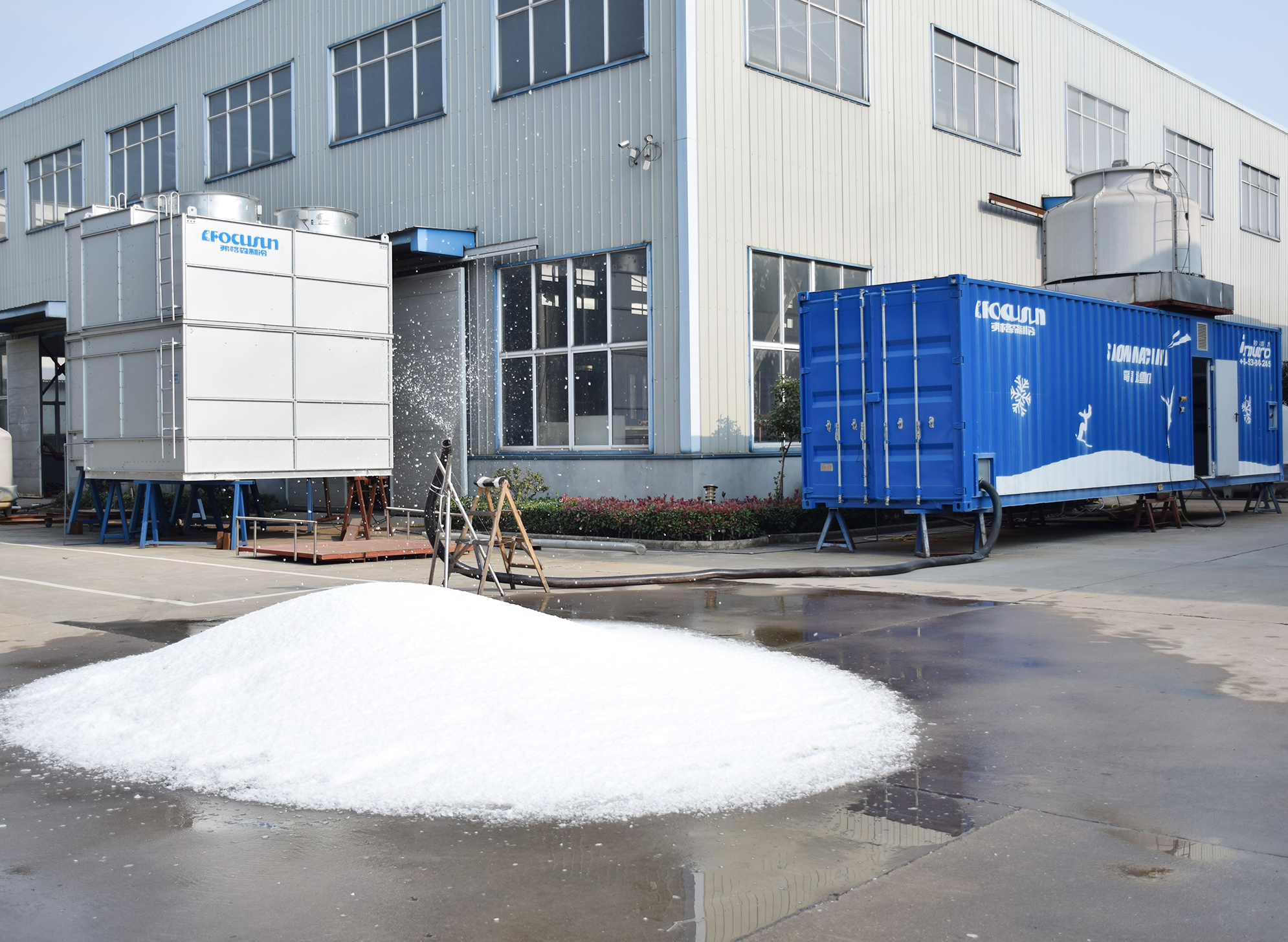
Higher production needs larger refrigeration and electrical infrastructure. Yet the biggest model is not always economical: initial filling and normal replenishment create different loads.
Separate initial filling, daily replacement and recovery. Confirm whether output is mass or volume, loose or compacted, and request performance at the maximum design condition.
Focusun’s guide to high-temperature snowmaking in warm climates provides context for why temperature assumptions matter.
Mechanical refrigeration permits production above freezing, but heat, humidity, sunlight and wind increase load and snow loss.
Indoors, heat enters through the enclosure, doors, visitors and lighting. Good snow room insulation can reduce electricity and replacement snow.
Do not compare machines at different test conditions. Require every supplier to use the same maximum air temperature, humidity, water temperature and operating hours.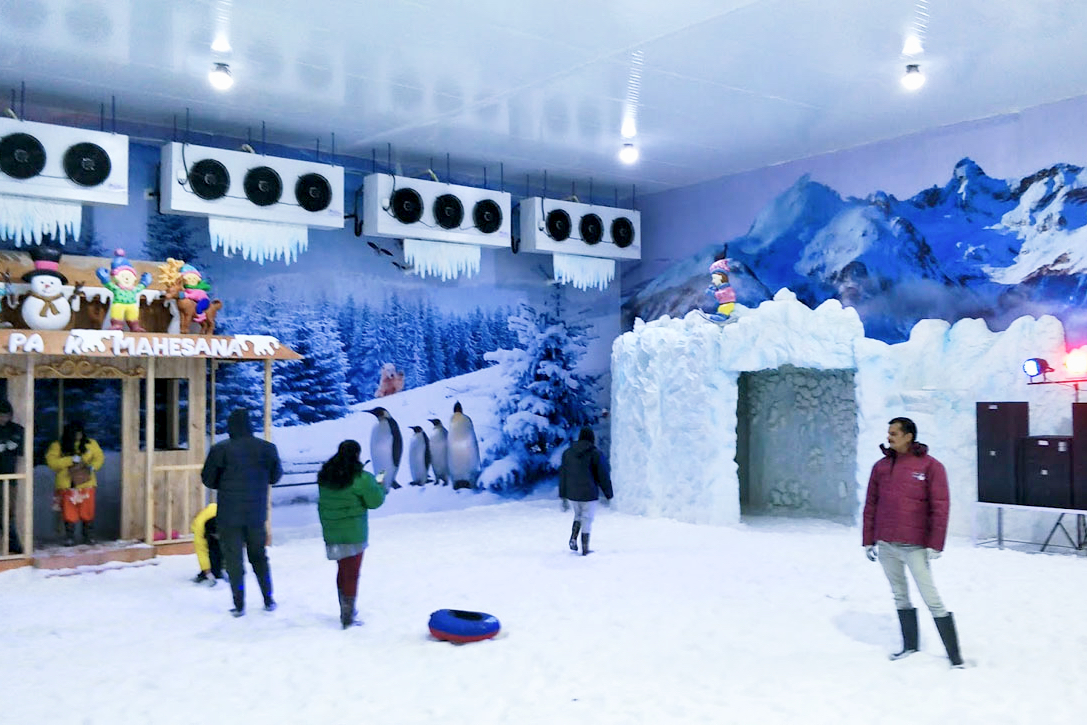
Containerized systems simplify factory assembly and deployment but still need foundations, lifting access, utilities and condenser clearance.
A site-built plant suits permanent venues and customized distribution but requires more local coordination.
Compare installed cost, maintenance access and expansion—not container size. Focusun’s year-round snow making machine manufacturer guide discusses project formats.
Electricity is often the largest technical expense. Estimate it from average operating power, scheduled hours and tariff—not installed power multiplied blindly by 24 hours.
Water cost includes snow production, treatment, cleaning and possible losses. Hardness or suspended solids can affect heat transfer, nozzles and maintenance. Air-cooled condensers need clean airflow; water-cooled or evaporative systems add pumps, water management and treatment.
Ask for connected load, expected running load, water consumption and heat-rejection requirements at the quoted duty.
Snow leaving the machine must reach the attraction. Long horizontal runs, elevation, bends and multiple discharge points may require blowers, conveyors, hoses, storage or staff handling. Snow can compact or warm during transport.
Provide a plan showing equipment position, destination, route length and height difference. A cheaper machine beside the wrong wall may create more labor and poorer coverage than a better integrated layout.
For complete venues, the indoor snow park design guide connects snow production with circulation, maintenance and technical rooms.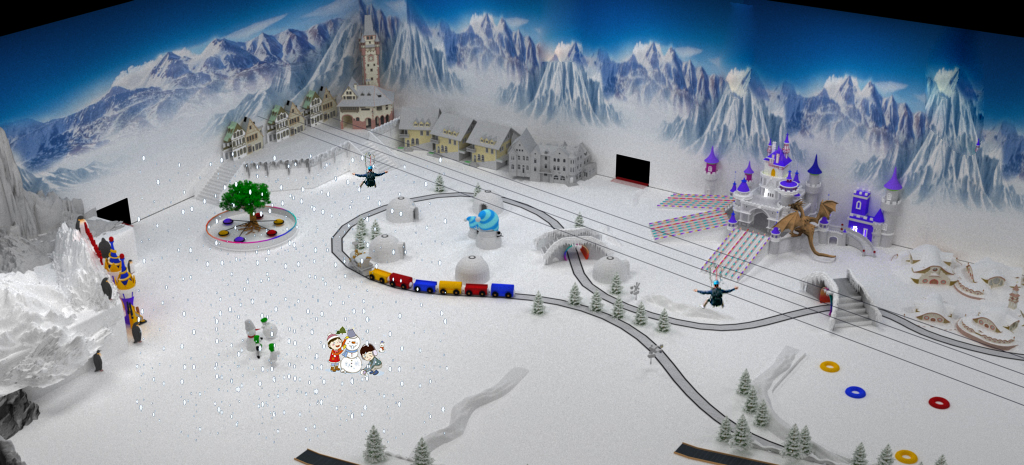
Clarify whether the quotation is EXW, FOB, CIF or delivered to site. Add ocean or road freight, insurance, port fees, import duty, tax, customs clearance, inland transport, cranes, technician travel, local labor and installation materials.
Commissioning should include safety checks, operating training and a capacity or snow-quality acceptance test under defined conditions. Budget for recommended spare parts and consumables before opening, especially where international delivery is slow.
Annual planning should include filters, water treatment, cleaning, lubrication where required, sensors, pumps, fans, compressor service, refrigerant leak checks and control support. Also include snow grooming, removal, drainage cleaning and staff time.
Redundancy costs more initially but may protect ticket revenue when one circuit is unavailable. Remote monitoring can shorten diagnosis, yet local technicians still need access, documentation and spare parts.
The lowest purchase price is not automatically the lowest cost per operating day. Compare energy, labor, maintenance, downtime risk and useful snow delivered.
Send one written project brief to every supplier. State climate, intended snow use, initial fill, daily replacement, operating schedule, utilities, distribution distance and responsibility boundaries. Require separate prices for equipment, optional accessories, freight, installation and commissioning.
The broader indoor snow park cost guide helps place snow equipment within a full attraction budget. For a tailored estimate, submit drawings and utility details through the Focusun project enquiry page.
There is no reliable single price because capacity, maximum ambient temperature, snow type, delivery distance, condenser design, automation and installation scope vary widely. A decorative snowfall machine and a containerized system for a snow park are fundamentally different purchases. Request a quotation against a defined output at your site conditions and ask the supplier to separate core equipment, accessories, freight, duties, installation and commissioning. This makes comparisons possible and prevents a low factory price from being mistaken for a complete operating project. Budget should also include utilities, water treatment, drainage, spare parts and staff training.
The largest drivers are required snow output, maximum temperature and humidity, operating hours, snow texture, redundancy and how far the snow must be transported. Electrical voltage, water quality, condenser arrangement, containerization, control level and materials also matter. Project cost rises when the site needs transformers, cooling towers, foundations, drainage, cranes or major building modifications. Suppliers should receive the same design brief so their prices reflect the same result. If one quote assumes mild weather and another guarantees production during the hottest period, the headline prices are not directly comparable.
Usually a smaller container has a lower equipment and shipping cost, but container length is not a dependable measure of value. Internal configuration, refrigeration capacity, snow output, redundancy, climate rating and delivery equipment determine performance. A compact system may be ideal for a smaller venue or staged expansion, while a larger package may offer lower unit cost at higher production. Compare guaranteed snow output, kilowatt-hours per unit of usable snow, maintenance access and installed utility requirements. Also confirm whether both quotations include the same controls, condenser, snow transport equipment, commissioning and spare parts.
Consumption depends on refrigeration capacity, ambient and water temperatures, snow output, operating hours, condenser efficiency and delivery equipment. Ask for connected power and expected average running power at the quoted duty; they are not the same. Estimate monthly energy by multiplying average kilowatts by scheduled hours and the local tariff, then add demand charges where applicable. A fair comparison also considers useful snow delivered, because a lower-power machine that produces less snow may not be cheaper. Indoor venues must add room refrigeration, dehumidification, lighting, entrances and grooming to the total project energy budget.
Most product water becomes snow, but total site consumption can also include water treatment, cleaning, condenser use and losses. The required quantity follows snow mass, so daily replacement demand is as important as machine capacity. Water-cooled or evaporative heat rejection may add consumption beyond the snow itself. Ask the supplier for product-water and condenser-water figures separately at the design condition. Test hardness, alkalinity, suspended solids and other relevant parameters before selecting treatment. Poor water quality can increase scaling, cleaning and downtime, turning a modest water bill into a significant maintenance cost.
Common exclusions include foundations, transformers, switchgear, cables, water tanks, treatment equipment, drainage, cooling towers, ventilation, piping beyond the machine, cranes, local labor, refrigerant, permits and building modifications. International quotations may also exclude freight, insurance, port charges, customs clearance, import duty, tax, inland delivery, technician travel and accommodation. Ask for a responsibility matrix showing who supplies, installs and tests each item. Confirm the delivery term and commissioning scope in writing. A complete site survey before purchase is often cheaper than discovering insufficient power, access or drainage after the equipment arrives.
It can be, but profitability depends on the business model rather than the machine alone. Estimate additional tickets, events, photography, food, retail or sponsorship enabled by reliable snow, then compare that contribution with electricity, water, rent, staff, maintenance and financing. Small venues should avoid buying slope-scale capacity when a targeted snowfall or play area meets customer expectations. Model conservative visitor numbers and include seasonal variation, downtime and marketing cost. The strongest case exists when guaranteed snow extends the operating season, supports fixed-date events or differentiates the venue enough to sustain pricing and repeat visits.
Buying usually suits permanent venues with frequent production, trained staff and a long operating horizon. Renting may suit a short event, market test or seasonal campaign when suitable equipment and technical support are locally available. Compare rental transport, setup, operator, utility and damage terms with ownership costs such as financing, storage, maintenance and depreciation. Availability is important: specialized refrigerated snow systems are less commonly rented than simple effect machines. If the project depends on a fixed date, confirm backup arrangements, output at local weather conditions and who is responsible for commissioning and on-site operation.
Begin by reducing the snow replacement load. Improve insulation and vapor control, shade outdoor areas where possible, manage doors, repair drainage problems and schedule production during more favorable conditions. Maintain condensers, water circuits, sensors and snow delivery equipment so the system does not run longer than necessary. Match production to measured losses instead of operating continuously by habit. Monitor energy, water and kilograms or cubic meters delivered each day. Staff should record weather, visitor levels and snow condition so settings can be adjusted from evidence. Oversizing, poor distribution and uncontrolled melting waste both capital and energy.
The quotation should identify the model, snow output, snow characteristics, design temperature and humidity, water conditions, connected and expected running power, water use, condenser requirements and operating limits. It should list snow delivery equipment, controls, monitoring, water treatment, piping, cables, spare parts and documentation. Commercial sections should define price, currency, validity, payment, Incoterm, freight, warranty, installation, commissioning, training and acceptance testing. Ask for exclusions and a responsibility matrix. A strong proposal also states the information that remains provisional, such as local utility upgrades, duties or civil work, so the final budget is not built on hidden assumptions.
