
When a food-processing company in Lagos decided to produce its own ice, the brief sounded simple: make 10 tonnes of clean tube ice every day and keep enough finished product frozen for dependable dispatch. In practice, the project also had to deal with heat, humidity, storage losses and overseas equipment support.
Focusun therefore treated the order as a complete cold-chain project rather than a machine sale. The delivered system combined a 10-ton-per-day tube ice machine with a 15-ton cold room, controls selected for continuous operation, and a layout that allowed the customer to move ice from production into storage without unnecessary handling.
The Lagos customer needed a stable supply of ice for food-processing and local cold-chain operations. Buying ice from outside suppliers left the business exposed to inconsistent availability, changing prices and quality that could not always be controlled. Producing on site would give the company more control, but only if the plant could maintain output during hot weather and protect the ice after it left the machine.
Ten tonnes per day is an average of roughly 417 kg every hour, yet customers and delivery vehicles do not arrive at an even rate. Without frozen storage, ice produced between dispatches can soften, clump or melt. Production and storage therefore had to work as one system.
Tube ice was a practical fit because it is clean-looking, slow-melting and easy to handle. The hollow pieces move well through hoppers, weighing equipment and bags, making them suitable for beverage service, distribution and food cooling. Focusun’s tube ice machine range covers small commercial units and larger industrial lines.
The Nigeria project produces 28 mm tube ice. This size offers a useful balance: it is substantial enough to hold well in drinks and during delivery, while remaining convenient for packing and everyday commercial use. All water and ice-contact areas were planned around hygienic production, an essential consideration when ice may touch food or beverages.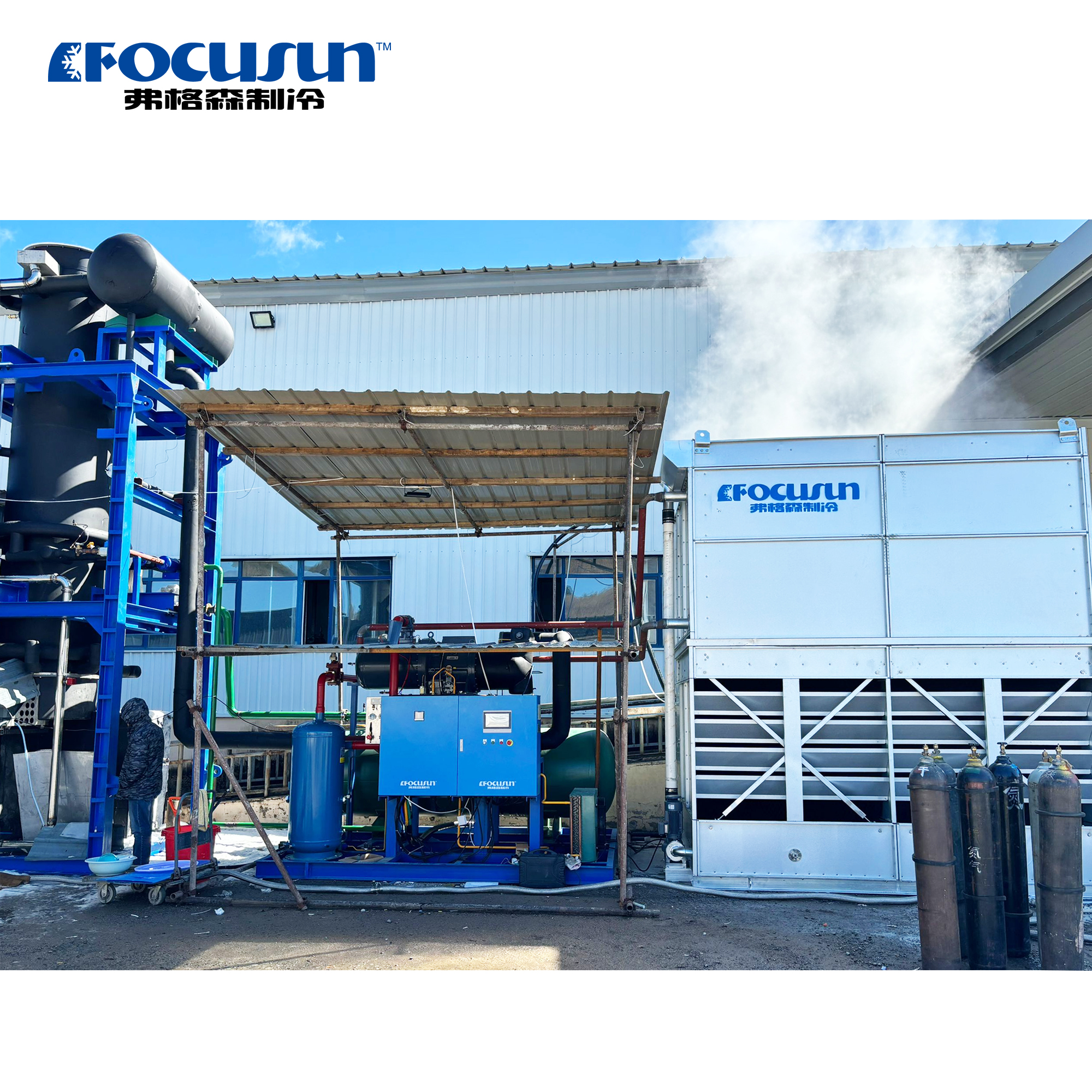
At the center of the project is a 10 tons/day tube ice machine. Its published standard configuration is rated at 10,000 kg per 24 hours under stated design conditions and uses a water-cooled refrigeration system. The Nigeria installation was equipped with a German Bitzer compressor, a Danfoss expansion valve and a Siemens PLC control system.
The compressor carries the refrigeration load, the expansion valve regulates refrigerant flow, and the PLC coordinates the sequence and safety logic. Internationally recognized components also make future parts identification easier overseas.
The automatic cycle reduces the amount of intervention required from operators. Water enters the evaporator, freezes on the inner surface of vertical tubes, and is released before being cut into consistent lengths. The operator’s job becomes monitoring water quality, pressures, alarms, ice condition and daily output rather than manually controlling each freezing cycle.
The accompanying cold room has a nominal holding capacity of 15 tonnes and operates between −10°C and −20°C. Polyurethane insulated panels limit heat gain, while efficient air coolers and intelligent temperature controls keep the room stable. Buyers planning a similar line can review Focusun’s cold room solutions for different products, room sizes and temperature requirements.
The extra capacity creates a buffer between production and delivery. It absorbs overnight output and protects the schedule when demand or transport timing changes. Good storage also helps bagged ice remain hard and free-flowing.
For a retail ice business, packing must be matched to daily output as carefully as the ice machine. A line may start with manual or semi-automatic bagging and later move to a fully automatic ice packing system. The correct choice depends on bag size, required bags per hour, labor cost, hygiene expectations and the dispatch schedule.
Hot and humid climates increase condensing pressure and make an ice machine work harder. Warm feed water adds another load. Focusun’s guide to ice machines for hot and humid climates explains why rated capacity should always be checked against the customer’s actual ambient temperature, inlet-water temperature, ventilation and cooling-water conditions.
For this project, water cooling provided dependable heat rejection, while the cold room was sized as an operating buffer rather than an afterthought. The site also needed adequate water pressure, drainage, electrical protection and access for maintenance. These details are rarely dramatic, but they decide whether a plant remains productive after commissioning day.
Before shipment, the main equipment was assembled and tested at Focusun’s factory. Factory testing allowed the engineering team to check the refrigeration circuit, control sequence, safety devices, ice formation and communication between components before the equipment traveled to Nigeria.
On-site installation and commissioning were completed in about 10 days. The work included positioning the equipment, connecting refrigeration, water and electrical services, assembling the cold room, testing operation and training the customer’s staff. Preparing utilities and the machine room before the shipment arrived helped keep the commissioning period short.
Once operational, the plant increased the customer’s in-house ice capacity, reduced dependence on outside suppliers and created a dependable year-round supply. The result was not achieved by the tube ice machine alone; it came from matching production, frozen storage, controls and site preparation.
The lesson for anyone planning a tropical tube ice plant is to define the complete workflow before requesting a quotation. Confirm the water analysis, maximum temperature, power and backup plan, ice diameter, bag sizes, peak sales, storage period and building dimensions.
Budget for the entire plant, not only the ice maker. Water treatment, cooling equipment, the cold room, packing, electrical works, freight, import charges and commissioning can materially change the investment. Focusun’s 10-ton ice plant cost guide separates these items so buyers can compare quotations more fairly.
If you are preparing a similar project, send the installation city, required daily output, water report, power supply, preferred bag size and factory drawing through the Focusun contact page. That information is enough for an engineer to begin checking capacity, layout and supporting equipment.
The final cost depends on much more than the tube ice machine. A complete project may include water treatment, a cooling tower, storage, conveyors, bagging equipment, electrical protection, a generator, freight, import duties and installation. Focusun’s current planning guide places complete 10-ton tube ice projects in a broad range of about US$160,000 to US$650,000 or more. A quotation for Nigeria should be based on the installation city, automation level, cold-room size, local power conditions and whether commissioning is included.
A machine rated at 10 tonnes per 24 hours averages about 417 kg per hour when it runs continuously under its stated design conditions. Actual hourly and daily output can change with ambient temperature, inlet-water temperature, condenser performance, cleaning time, power interruptions and maintenance condition. Buyers should ask for expected production at their hottest local conditions rather than assuming the nameplate figure is guaranteed in every environment. Storage and packing equipment must also be able to handle the real production rate.
It can be suitable for an established distributor or a new business with proven demand, but 10 tonnes per day is a commercial-scale commitment. Before ordering, estimate peak sales by customer type, delivery route, bag size and season. At full output, the plant could produce 5,000 two-kilogram bags or 2,000 five-kilogram bags per day. The business also needs reliable power, treated water, frozen storage, vehicles, trained operators and working capital. A smaller plant may be safer when demand has not yet been validated.
Cold-room capacity should reflect the dispatch pattern, not simply match one day of production. A plant delivering continuously may need less buffer, while a business that produces overnight and loads vehicles in the morning needs more. The Lagos project paired 10 tonnes of daily production with a 15-ton cold room, giving the operator useful flexibility. Final room dimensions depend on bag size, pallet or floor stacking, aisle space, door openings, target temperature, loading frequency and how many days of safety stock the business intends to keep.
Yes, provided the refrigeration and heat-rejection systems are selected for the actual site. High ambient temperatures and warm inlet water can reduce output if the condenser is undersized or the machine room traps heat. Water cooling is often a practical choice for larger tropical plants when water quality and supply are manageable. The design should also include ventilation, scale control, voltage protection and enough maintenance clearance. Ask the supplier to state expected output at the maximum local temperature, not only at standard test conditions.
Focusun’s standard 10-ton tube ice machine supports three-phase supplies from 220 V to 480 V at 50 or 60 Hz, depending on configuration. Its published running power is about 34.95 kW and installed power is 45 kW, but this is not the load for the whole factory. Pumps, water treatment, packing equipment, lighting and cold-room refrigeration add to demand. A generator and transformer must be sized for total connected load and compressor starting current, with phase-loss, overvoltage, undervoltage and surge protection.
The treatment system should be chosen after a laboratory water analysis. Depending on the source, it may include sediment filtration, activated carbon, softening, reverse osmosis, ultraviolet sterilization or ozone treatment. The finished water must meet applicable drinking-water and food-safety requirements because the ice may contact beverages or food. Correct treatment also reduces scale inside the machine and improves ice clarity. Over-specifying treatment wastes water and electricity, while under-treating creates hygiene, appearance and maintenance problems, so a local water report should be supplied before equipment selection.
Neither type is universally better. Tube ice is well suited to beverages, restaurants, hotels, supermarkets and packaged retail sales because it has an attractive shape and is easy to weigh and bag. Block ice generally melts more slowly and may be preferred for fisheries, remote markets and long transport where cold storage is limited. Tube ice plants usually require stronger water-treatment, hygiene, packing and frozen-storage arrangements. The better investment depends on local customers, selling price, delivery distance, labor availability and the type of ice already accepted in the market.
Staffing depends mainly on the level of automation and the delivery operation. The ice-making cycle itself is automatic, but the plant still needs supervision, cleaning, quality checks, bagging, cold-room handling, maintenance and vehicle loading. A semi-automatic packing line requires more operators than a fully automatic weighing and sealing system. Instead of choosing a fixed headcount from a brochure, map every shift from water treatment to dispatch. Automation can reduce repetitive handling, but trained personnel are still needed to monitor alarms, record output and maintain hygienic production.
Operators should check water flow, ice quality, production time, pressures, leaks, unusual noise and control-panel alarms every day. Water filters, condenser surfaces, pumps and electrical terminals require scheduled inspection, while the evaporator and water circuit need hygienic cleaning and descaling at intervals based on water quality. The cold room also needs door-seal, fan, defrost and insulation checks. Keeping common sensors, contactors, seals and filter elements on site reduces downtime. A simple operating log helps technicians notice gradual changes before they become a shutdown.
